
Founding and Early Years (1920 - 1955)
-
1924: First steps taken at the National Conference on Social Work
-
During a luncheon meeting at the 1924 US National Conference on Social Work in Toronto, the first official actions are taken to create the Canadian Association of Social Workers. Many Canadians belonged to American counterpart associations, but the need for a uniquely Canadian association is agreed on. These first volunteers draft by-laws and recruit members from various municipal social work clubs.
-
1926: Founding of Canadian Association of Social Workers
-
On September 1st of 1926, the Canadian Association of Social Workers finalizes their first constitution and establishes the first national professional association for social workers in Canada. The organization begins with 197 charter members across Canada.
"It is the professional Association of Canadian Social Workers, and its formation will perhaps be the first indication to many that the problems of inequalities and human relationship which arise from and live to burden our social structure have evolved a profession of social workers to meet them [...]" -
1928: First general meeting held
-
The first general meeting of CASW is held in Toronto in April of 1928.
-
1920s-'30s: First CASW branches formed
-
Over the first 15 years of CASW, member branches form. The first are Montreal and Toronto (1927). This is followed by others, including Hamilton and the British Columbia Mainland (1928), and Manitoba (1930). These are not independent provincial organizations, but groupings of CASW members which discussed – among other things – next steps in provincial organizing.
-
1932: Launch of The Social Worker / Le travailleur social
-
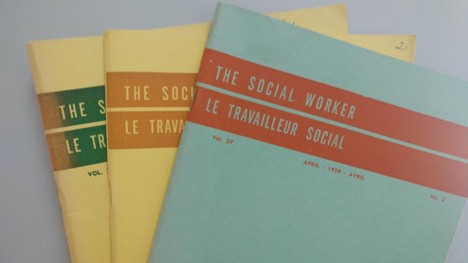
Launch of The Social Worker (later The Social Worker / Le travailleur social), CASW's publication of social work research and news on the state of social work and CASW's operations across Canada. Prior to this, pronouncements were published in Social Welfare, the publication of the Social Service Council of Canada. The Social Worker becomes bilingual in 1956 and changes its title.
-
1938: First national Code of Ethics
-
Following six years of study, the first basic Code of Ethics is adopted. The 1938 Code of Ethics is only used for two years, and is temporarily discontinued in 1940 following concerns about due process and an overly punitive focus. Points in this first Code of Ethics include an essential responsibility for the welfare of clients, and a commitment to continuing education and study.
-
1941: Canadian social workers sent to England during WW2
-
During the Second World War, Canadian social workers through CASW and the Canadian National Committee on Mental Hygiene are sent to England to aid the British Ministry of Health.
-
1944: First national office opened
-
The first national office for the CASW is opened in Ottawa, Ontario.
-
1946: First French-language chapter is formed in Quebec City
-
The first chapter of the CASW focused on Francophone operations and services is formed in Quebec City in 1946 – followed in 1955 by the Montreal French chapter. Concerns are raised at the time about the possible divisiveness of language-oriented chapters, and how these chapters fit with the existing explicitly religious organizations in the province.
-
1947: Submission to Senate-Commons Committee promoting assimilation
-
CASW presents a joint submission with the Canadian Welfare Council to the Senate-Commons Committee on Indian Affairs. This submission contains some criticism of residential schools (preferring on-reserve day schools), but ultimately endorses their implementation – along with full integration of the State into Indigenous family life and education. While emphasis is placed on the impact of poverty and lack of social services, intervention is justified on the grounds of Indigenous cultural backwardness. Additionally, calls for increased foster care directly foreshadow the impending tragedy of the Sixties' Scoop.
"There is a lack of community organization which would develop such incentives, and which, with good leadership, could help Indians, irrespective of their social situation, to raise their level of living above primitive conditions which still exist widely to a standard more in keeping with their dignity as human beings in a modern civilized country." -
1951: Newfoundland branch is formed in new province
-
Two years after Confederation with Canada, social workers in Newfoundland create the first CASW branch in the new province. Regulation of the profession in Newfoundland and Labrador will not be achieved until 1993.
-
c. 1954: CASW joins the International Federation of Social Workers
-
Around this time, CASW joins the International Federation of Social Work (IFSW). In 1954, the IFSW holds an international meeting in Toronto.
Growth and Incorporation (1956 - 1973)
-
1956: CASW is incorporated as a national non-profit
-
Despite being formed 30 years earlier, CASW is first incorporated in 1956 under the Dominion of Canada Companies Act of 1935.
-
1956: British Columbia Association of Social Work is incorporated
-
The British Columbia Association of Social Workers (BCASW) is incorporated through the Society Act. This is the first provincial group to incorporate.
-
1960: Corporation of Professional Social Workers of the Province of Quebec is incorporated
-
Corporation of Professional Social Workers of the Province of Quebec / Corporation des travailleurs sociaux professionnels de la province de Québec is incorporated through a Private Bill of Legislature. In 1974, this organization will be renamed l’Ordre professionnel des travailleurs sociaux du Québec following legislative changes.
-
1960: Corporation of Professional Social Workers of the Province of Quebec is incorporated
-
Corporation of Professional Social Workers of the Province of Quebec / Corporation des travailleurs sociaux professionnels de la province de Québec is incorporated through a Private Bill of Legislature. In 1974, this organization will be renamed l’Ordre professionnel des travailleurs sociaux du Québec following legislative changes.
-
1962: Alberta Association of Social Workers is incorporated
-
The Alberta Association of Social Workers (AASW) is incorporated through the Societies Act.
-
1962: Manitoba Association of Social Workers is incorporated
-
The Manitoba Association of Social Workers (MASW) is incorporated through the Companies Act.
-
1963: Saskatchewan Association of Social Workers is incorporated
-
The Saskatchewan Association of Social Workers (SASW) is incorporated through the Societies Act.
-
1963: Nova Scotia Association of Social Workers is incorporated
-
The Nova Scotia Association of Social Workers (NSASW) is incorporated through an Act of Legislature.
-
1964: New Brunswick Association of Social Workers is incorporated
-
The New Brunswick Association of Social Workers (NBASW) is incorporated through an Act of Legislature.
-
1964: Ontario Association of Professional Social Workers is incorporated
-
The Ontario Association of Professional Social Workers (later Ontario Association of Social Workers) is incorporated through the Companies Act.
-
1968: Statements supporting legalization of contraception
-
In response to both the ongoing ban on distributing contraception for non-medical reasons, as well as the global panic about overpopulation, CASW releases a statement sent to the Commons Committee on Health and Welfare calling for a removal of all reference to contraception in Section 150 of the Criminal Code. The fact that barriers to accessing Planned Parenthood disproportionately affect low-income Canadians is emphasized. Contraception is legalized the following year.
"The major obstacle in Canada to Planned Parenthood is an obsolete and unworkable provision of the Criminal Code which constitutes a barrier to the equitable use of information and means whereby parents can space and plan their children." -
April 20, 1968: Opposition to total criminalization of abortion
-
CASW writes a statement to Prime Minister Pierre Trudeau, stating a position that abortion is a "problem" and not a generally acceptable means of resolving pregnancy, but that exceptions must be made for when the life of the parent is at risk. The statement also casts doubts on how generally effective the criminal justice system is at reducing illegal abortions, especially given class disparities, and suggests that social supports are a necessary part of any response. Additionally, it suggests that social workers, theologians, and mental health professionals – rather than only surgeons – should be involved in the decision whether or not to abort.
-
1970: Newfoundland Association of Social Workers is incorporated
-
The Newfoundland Association of Social Workers (NASW) is incorporated under the Corporations Act. In 2019, the association is retitled as the Newfoundland and Labrador College of Social Workers (NLCSW) to reflect its new regulatory role.
Federation (1974 - 1999)
-
1974: CASW becomes a national federation
-
At a meeting held in Ottawa in December of 1974, by-laws are first accepted approving the transition of CASW into a federation of regional associations – formerly branches, under the previous structure.
-
1975: Brief presented to Parliamentary Committee on the Green Paper on Immigration
-
CASW presents a brief to the Parliamentary Committee on the Green Paper on Immigration, detailing several concerns and suggestions for immigration reform and the role of social workers. These include creating more rigorous criteria for refugee claims and expanding them to include political refugees, creating a category of "temporary citizen" to afford more rights to visiting students, and protecting the right of appeal to an independent and separate tribunal for immigration decisions. The Green Paper is accused of scapegoating immigrants for all social ill, and promoting a framing of immigration which may be used to promote white-only immigration.
-
1986: Opposition to restoration of capital punishment
-
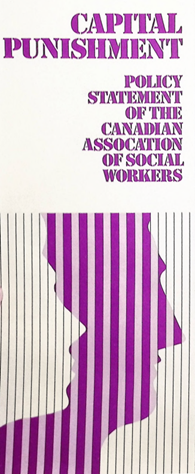
In 1986, CASW publishes a multiple-page statement in pamphlet form entitled "Opposition to Capital Punishment", refuting various arguments for the death penalty and opposing its proposed reintroduction. In the statement, CASW condemns capital punishment as fundamentally at odds with social work values, as it serves to diminish the value placed by society on human life and disproportionately affects the racially and economicaly marginalized – particularly First Nations.
"The Canadian Association of Social Workers maintains that the integrity of human life and the promotion of human well-being are among the highest values to which a society aspires. The practice of capital punishment which entails a deliberate act of execution by the state is therefore at variance with the fundamental values of the social work profession." -
1987: Canadian Social Work Foundation founded
-
The Canadian Social Work Foundation (CSWF) is created as a charitable foundation by the CASW, in order to promote "the advancement of knowledge in the field of social work." Actions of the CSWF include providing conference grants.
-
1988: Prince Edward Island Social Workers Association is incorporated
-
Prince Edward Island Social Workers Association (PEISWA) is incorporated under the Social Work Act (1988).
-
1989: Opposition to Goods and Services Tax (GST)
-
In 1989, CASW makes its first statement opposing the Goods and Services Tax (GST), arguing that it is regressive rather than progressive (like bracketed income tax), and will disproportionately affect low-income Canadians.
-
1993: Brief presented to Royal Commission on Aboriginal Peoples
-

CASW presents a brief to the Royal Commission on Aboriginal Peoples, convened from 1991-1996 to investigate the relationship between Indigenous Peoples and the Canadian government and society. The brief presented explains the relationship of the social work profession to Indigenous Peoples in Canada and proclaims support for reconciliation and self-government.
"The lessons of the past are often-times painfully learned. We know that much pain continues to exist and that much work still needs to take place to heal the damage that was done" -
1993: Official languages policy implemented
-
As part of the mandate of representing social workers across Canada, a statement on CASW's languages policy is made, which establishes co-existence of French and English as a priority of the Association and that all communications with the national office can be in either language.
-
1993-1997: "The National Social Work Response to HIV/AIDS Position, Skill Building and Support"
-
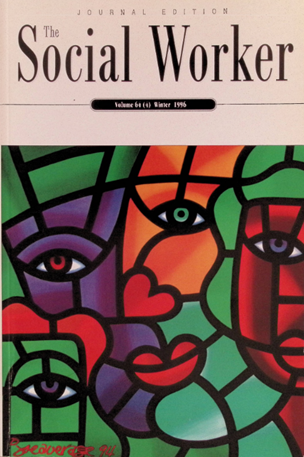
Both independently and as part of the Health Canada's National AIDS Strategy, CASW ran a four-year project aimed at supporting persons living with HIV/AIDS. This included an extensive statement on the seriousness of non-discrimination for persons with HIV/AIDS, the importance of all social workers being educated on the disease and its related social impacts, as well as restating the importance of confidentiality. CASW delivered its first statement on HIV/AIDS in 1989. Also part of the project was a special edition of The Social Worker (The Social Worker, Volume 65, Number 2) on HIV.
"Julie Foley, President of CASW states that 'AIDS affects many Canadians and Social Workers have and will continue to play a key role in this epidemic'." -
1994: First Distinguished Service Awards are given
-
During the CASW National Social Work Week in 1994, the first Distinguished Service Awards are given out to 8 recipients.
-
1998: First National Award for Outstanding Service given
-
The first biennial National Award for Outstanding Service (later Glenn Drover Award) is given to Gail MacDougall of the Nova Scotia Association of Social Workers.
The New Millennium (2000 - Present)
-
2001: Association of Social Workers in Northern Canada joins CASW
-
The Association of Social Workers in Northern Canada (ASWNC), a non-regulatory professional association representing social workers in Yukon, Nunavut, and the Northwest Territories, joins CASW.
-
2002: First Memorandum of Understanding with the National Association of Social Work
-
The United States' National Association of Social Work (NASW) and the CASW sign a Memorandum of Understanding. This involves a commitment to jointly addressing international issues and cooperating despite any political tensions between the two countries. This MOU has been reaffirmed multiple times since (2018, 2020, 2024) and now includes a commitment to rotate the presidency and vice-presidency of the North American Region of the International Federation of Social Work.
-
2002: Julie M. Foley receives National Award for Outstanding Service
-
Julie M. Foley of the Ontario Association of Social Workers receives the National Award for Outstanding Service.
-
2003 - 2005: Support for same-sex marriage (Bill C-38)
-
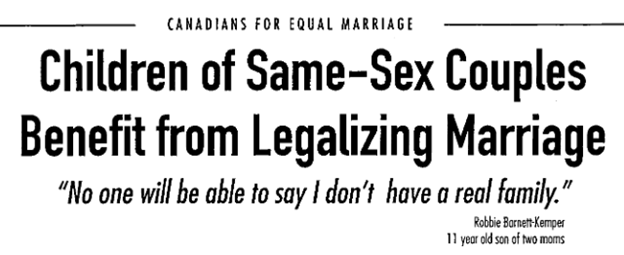
During the 2000s, as part of the Coalition for Equal Marriage, CASW makes multiple submissions to the House of Commons asserting the need for recognizing same-sex marriages. The specific contribution from CASW disputes the argument that recognition would harm children, and argue the contrary – that non-recognition creates instability for children of same-sex parents.
"' […]In fact, same-sex couples do have and raise children and excluding them from marriage would only harm those children,' said Eugenia Moreno, Executive Director of the Canadian Association of Social Workers." -
2004: L’Ordre professionnel des travailleurs sociaux du Québec leaves CASW
-
After almost 50 years of membership (through its predecessors), l’Ordre professionnel des travailleurs sociaux du Québec leaves CASW.
-
2004: John Mould receives National Award for Outstanding Service
-
John Mould of the Alberta College of Social Workers receives the National Award for Outstanding Service.
-
2004: Canadian Social Work Journal first published
-
Following the end of publication for The Social Worker / Le travailleur social, Canadian Social Work Journal emerges as CASW's principal publication.
-
2005: Launch of The Reporter
-
The Reporter, an internal monthly summary of CASW activities, is first distributed.
-
2006: Memorandum of Understanding with the Canadian Association of Schools of Social Work
-
A Memorandum of Understanding is signed between CASW and the Canadian Association of Schools of Social Work (later renamed Canadian Association of Social Work Education), agreeing to communicate and collaborate more closely on common issues.
-
2006: Dan Andraea receives National Award for Outstanding Service
-
Dan Andraea of the Ontario Association of Social Workers receives the National Award for Outstanding Service.
-
2008: Dr. Beverley J. Antle receives National Award for Outstanding Service
-
Dr. Beverley J. Antle of the Ontario Association of Social Workers receives the National Award for Outstanding Service.
-
2008: First Memorandum of Understanding signed with the Intersectoral Committee
-
The first Memorandum of Understanding is signed with the Intersectoral Committee, committing to collaboration between the three sectors of social work (aducation, association, and regulation). At this point, there is no national organization for regulation, so a representative from a provincial/territorial body represents the sector. Governance is done through voting.
-
2009: Acknowledgement of social work’s role in colonialism
-
A statement is released on following Prime Minister Stephen Harper's 2008 apology for the Residential Schools System. CASW acknowledges the involvement of social workers in colonization and commits to learning from the past and working to "heal the damage that was done."
"Until recently, social work education offered no insight into Aboriginal traditions, languages or values. In many social service systems, Aboriginal peoples have been denied their language, history, identity, and ultimately, their dignity." -
2010: Cindy Blackstock receives National Award for Outstanding Service
-
Cindy Blackstock of the Ontario Association College of Social Workers receives the National Award for Outstanding Service.
-
2011: Ontario Association of Social Workers leaves CASW
-
Following concerns regarding fee structures and voting, the Ontario Association of Social Workers leaves the CASW federation.
-
2011: Alberta College of Social Workers leaves CASW
-
Due to various concerns, the Alberta College of Social Workers leaves the CASW federation.
-
2011: Individual membership category created
-
Following the exit of the Ontario Association of Social Workers and the Alberta College of Social Workers from the federation, a category of individual membership is created for members from the three non-federation provinces (AB, ON, QC).
-
2012: Dr. Michael Ungar receives National Award for Outstanding Service
-
Dr. Michael Ungar of the Nova Scotia College of Social Workers receives the National Award for Outstanding Service.
-
2014: Madeleine Dubé receives National Award for Outstanding Service
-
Madeleine Dubé of the New Brunswick Association of Social Workers receives the National Award for Outstanding Service.
-
2016: National Award for Outstanding Service is renamed after Dr. Glenn Drover
-
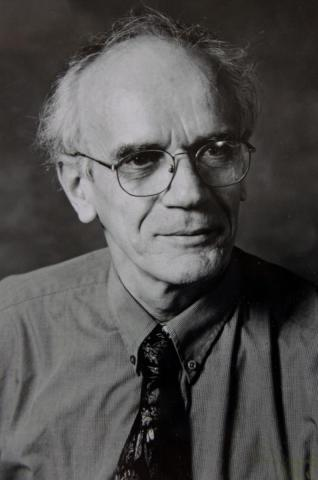
The National Award for Outstanding Service is renamed as the Glenn Drover National Award for Outstanding Service, with Glenn Drover being posthumously made the first recipient of the renamed award.
-
2016: Second Memorandum of Understanding signed with the Intersectoral Committee
-
A renewed second Memorandum of Understanding is signed between the members of the Intersectoral Committee, now including the Canadian Council of Social Work Regulators (rather than a representative from a provincial/territorial regulatory body). Also included is a new commitment to consensus as the model of governance.
-
2016: Canadian Social Work Foundation dissolved
-
The Canadian Social Work Foundation officially ends operations and is dissolved.
-
2016: Alberta College of Social Workers rejoins CASW
-
After five years of separation, the Alberta College of Social Work rejoins the CASW federation as a provincial partner.
-
2018: Dr. Mary Valentich receives the Glenn Drover National Award for Outstanding Service
-
Dr. Mary Valentich of the Manitoba College of Social Workers receives the Glenn Drover National Award for Outstanding Service.
-
2019: Canadian Social Work Journal ends
-
The Canadian Social Work Journal publishes its 20th and final issue.
-
2019: CASW Statement of Apology and Commitment to Reconciliation
-
A more comprehensive statement is made on the involvement of social workers in the forced assimilation and cultural genocide of Indigenous communities in Canada. CASW's 1947 submission (promoting forced assimilation) is detailed, as is the 1993 submission to the Royal Commission on Aboriginal Peoples (generally rejecting it), and how these actions continue to cause poverty and Missing and Murdered Indigenous Women and Girls.
-
2020: Ellen Oliver receives the Glenn Drover National Award for Outstanding Service
-
Ellen Oliver of the Newfoundland and Labrador Association of Social Workers receives the Glenn Drover National Award for Outstanding Service.
-
September 15, 2020: Memorandum of Understanding with Association of Black Social Workers
-
The Association of Black Social Workers (ABSW) and CASW sign a historic Memorandum of Understanding recognizing systemic racism and committing to pursuing practices and services that will help Black/African Canadian communities. This includes rectifying and resisting the psychological trauma of racism, and promoting community development towards justice.
“'This formal understanding values our reciprocal relationship and the benefits inherent in exchanging information of mutual interest with an emphasis on programs and services that enhance the lives of people of African descent' stated ABSW President, Rajean Willis." -
2021: Ontario Association of Social Workers rejoins CASW
-
The Ontario Association of Social Workers (OASW) rejoins CASW with the signing of a federation partnership agreement. This follows 10 years of separation.
-
2022: Support for l'Association québécoise des Travailleuses sociales et Travailleurs sociaux begins
-
CASW supports the establishment and growth of l'Association québécoise des travailleuses sociales et travailleurs sociaux (l'AQTS).
-
2022: Marion Bogo receives the Glenn Drover National Award for Outstanding Service
-
Marion Bogo of the Ontario Association of Social Workers posthumously receives the Glenn Drover National Award for Outstanding Service.
-
2022: Statement on Abortion Access in Canada
-
Following the overturning of Roe v. Wade in the United States, CASW releases a new official statement on abortion. Unlike the 1968 statement, the 2022 statement does not describe abortion as acceptable only in cases of potential injury, but instead as a matter of "reproductive rights and reproductive justice." Abortion is specifically described as a human right and as part of self-determination, a principle of the CASW Code of Ethics. Various barriers to access, from faith-based hospitals to social stigma and racial distrust, are described.
"The Canadian Association of Social Workers (CASW) is pro-reproductive rights. The CASW Code of Ethics privileges self-determination, and the Association affirms that timely, accessible abortion is not only health care, but a human right." -
December 31, 2022: Alberta College of Social Workers divests and leaves CASW permanently
-
In respond to 2020 amendments to the Health Professions Act, the Alberta College of Social Workers (ACSW) is forced to divest its association mandate. As a result, ACSW permanently leaves the CASW federation in 2022.
-
April 2023: Social Workers Association of Alberta joins CASW
-
The Social Workers Association of Alberta (SWAA) joins CASW as a federation partner. SWAA was created in 2023 to replace the Alberta College of Social Workers (ACSW), which was forced to divest its association and regulatory mandates in response to the 2020 Health Professions Act.
-
2023: CASW President elected as International Federation of Social Workers Global Vice President
-
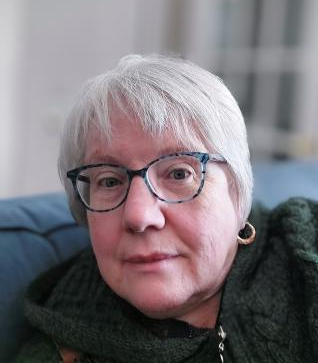
CASW President Joan-Davis Whelan is chosen as Vice-President of the International Federation of Social Workers – the first Canadian to hold the position.
-
2024: Joan Churley receives the Glenn Drover National Award for Outstanding Service
-
Joan Churley of the Manitoba College of Social Workers receives the Glenn Drover National Award for Outstanding Service.
-
2025: Intersectoral Relationship Agreement signed
-
A committee relationship agreement is signed between representatives of the sectors of social work (education, association, regulation), agreeing to values like mutual respect and communication. Best practices like non-disparagement and respect for distinctness of the sectors are agreed to, and the role of the facilitator is restated.
-
2026: Inclusion in Canada Student Loan Forgiveness achieved
-
After more than two decades of advocacy by CASW, the Government of Canada includes social workers among the professions eligible for the Canada Student Loan Forgiveness program.