-
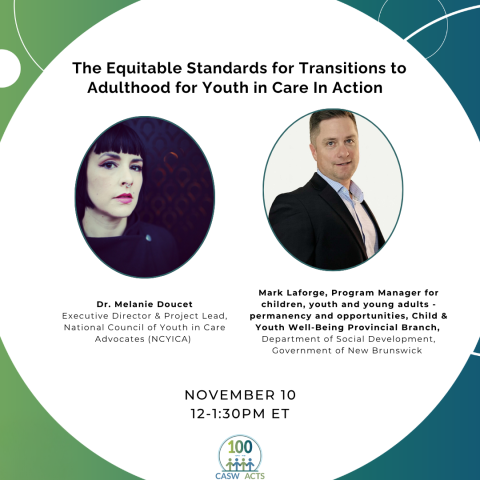
Mark Laforge, Program Manager for children, youth and young adults - permanency and opportunities, Child & Youth Well-Being Provincial Branch, Department of Social Development, Government of New Brunswick
Mark Laforge is from Grand-Falls, New-Brunswick, and has been working for the provincial government with the Department of Social Development for 25 years. He holds a Bachelor’s in Social Work as well as a Public Administration Certificate. Mark’s work experience has always been with children and youth services where he held numerous different positions as a front-line social worker in Child Protection, as a Family Group Conference Coordinator and as an After-Hours Emergency Service supervisor. Since 2015, his responsibilities have been in management as a Provincial Program Manager in service delivery and program design. Currently Mark is leading the work being done in New Brunswick in expanding and modernizing services under the newly established Youth Engagement and Young Adults (YEYA) program and the implementation of the new Child & Youth Well-Being Act.
Dr. Melanie Doucet, PhD Social Work, Executive Director & Project Lead, National Council of Youth in Care Advocates (NCYICA)
Dr. Doucet has been working to improve the lives of youth in care for nearly 20 years. She is a former youth in care originally from New Brunswick, and is now based in the unceded traditional territory of the Kanyenʼkehá꞉ka (Mohawk) Nation in Montreal, Quebec. She holds a PhD in Social Work, is an expert consultant, an Adjunct Professor at the McGill University School of Social Work, a member of the McGill Centre for Research on Children and Families (CRCF) and the Executive Director of the newly established lived experience-led organization, the National Council of Youth in Care Advocates (NCYICA). Dr. Doucet is a renowned public and keynote speaker on the importance of equitably supporting youth in and from care from a rights-based and humane perspective, and is an award-winning researcher. She continues to work as part of provincial, territorial and national youth in care advocacy communities on child protection policy and practice reform initiatives, and is currently leading the Equitable Transitions to Adulthood for Youth in Care project alongside the members of the National Council of Youth in Care Advocates.